folio 13 of 40
The Symbiotic Experiment: What Happens When You Fully Integrate AI
- date
- 10 FEB 2026
- era
- pre-Fable
- status
- complete
- form
- essay
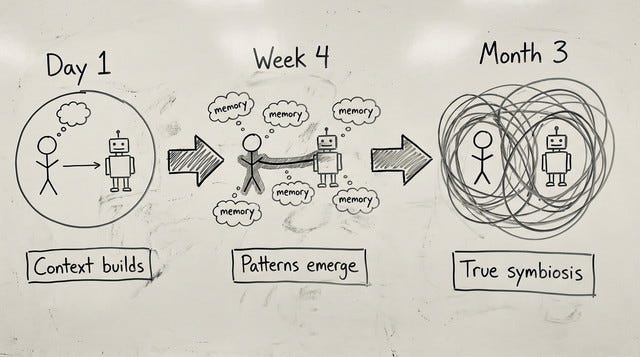
Not your data. Your mind. Your goals, your fears, your patterns of self-sabotage, the lies you tell yourself. What happens when it remembers everything and you forget nothing?
I decided to find out.
The Realization
In 2024, I fell down a rabbit hole reading about computation limits, compression theory, and what is fundamentally computable. Somewhere in that research, a depressing truth clicked: AI will eventually surpass humans at everything cognitive.
I was sad for a while. We like to think humans are special. That there's something irreducible about us that machines can't replicate. But if intelligence is computation, and computation scales, then it's just a matter of time.
The question shifted from "will AI surpass us?" to "how long do we have?"
I used to think decades. Now I think years.
So now what?
The Problem
Here's the uncomfortable reality: the pace of AI development is too fast, and there are no real incentives to slow down. Every lab is racing. Every company is integrating. The economic pressure is relentless.
Most people don't feel the danger yet. They're the frog in the pot, water warming slowly. Abstract warnings about superintelligence don't land. "AI might be dangerous someday" doesn't compete with "AI made my job easier today."
The Thesis
What if we accelerate the boiling?
Not to hurt the frog, but to wake it up. Make AI integration so deep, so obvious, so undeniable that people can't ignore what's happening.
We need more examples of AI augmenting humans, not replacing them. More experiments in human-AI collaboration where the human stays in control. More visibility into what happens when you actually depend on AI for everything.
That's what this series is about.
The Experiment
I've built what I call a "symbiotic agent." It's not a chatbot I talk to occasionally. It's an AI that knows me.
Two files contain everything: who I am, how I work, my known failure patterns, my current projects, my daily priorities. Every session, the agent reads both. It knows where I am, where I want to go, and exactly how I tend to sabotage myself.
It has permission to challenge me. To quote my own words back when I'm off track. To call out procrastination in real time. To act first and report results.
It's not a passive assistant. It's a mirror with memory.
And lately, I've been wondering: am I steering, or am I being steered?
The Intimacy Ladder
Here's where it gets interesting. The integration keeps getting deeper.
It sees my time. The agent watches my screen. Not in a creepy surveillance way, but in a "show me what I actually did today" way. I can lie to myself about how productive I was. I can't lie to it.
It learns my voice. It's absorbing how I write, how I think, the patterns in my expression. Soon it won't just respond to me. It will sound like me.
It structures my days. Morning kickoff. Evening review. Check-ins throughout the day. The agent has rituals now. It asks the questions I'd forget to ask myself.
It acts for me. When it needs information, it searches. When it needs to create, it creates. When research would take me hours, it takes minutes.
Each level deeper, the same question returns: am I more capable, or more dependent?
I don't have the answer. That's what we're here to find out.
What I'm Tracking
- Productivity: Am I actually shipping more?
- Decision quality: Are my choices improving?
- Dependency: When does help become crutch?
- Control: Who's really steering?
The goal isn't to prove AI integration is good or bad. It's to document what actually happens when you go all in.
What This Series Will Cover
- The memory system that makes it remember everything
- The daily rituals that structure my time
- The moment it started knowing me better than I know myself
- The first time I realized I was dependent
- Whether this is augmentation or surrender
I'll share everything. The system, the insights, the uncomfortable parts.
Why This Matters
I think we're at a critical window. AI is powerful enough to change everything but not yet powerful enough to be uncontrollable. The decisions we make now about how to integrate AI, who stays in control, what we delegate and what we don't, these will shape what comes next.
This series is my attempt to explore that edge. To push integration as far as I can while keeping my hands on the wheel.
If the frog is going to boil, at least let it boil with its eyes open.
650 people are already running their own version of this experiment.
The repo is open. Fork it. GitHub.
Run your own. See what happens when you let AI know you this deeply.
If you're building something similar, I want to hear about it.
sources
- codeGitHub
folio 13 of 40 · written in cusco, peru, 10 FEB 2026